Sambo’s Restaurant
(Alternatively Lil’ Sambo’s)
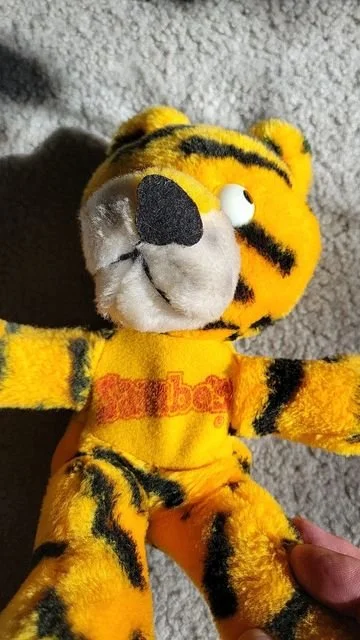
Midland’s franchise of the national chain, Sambo’s, stood at the corner of North Saginaw and Eastman Roads. The pancake diner once boasted 1,117 restaurants in 47 states before falling on financial hardship and declaring bankruptcy in the 1980s.
The restaurants featured menu item names and murals from a children’s book called Little Black Sambo. Helen Bannerman wrote a story called Little Black Sambo, published in 1899, on a trip back to India from her home in Scotland. The story was steeped in colonial tropes about the superiority of white colonists. Historian Naa Oyo A. Kwate points out that “Black” as part of Sambo’s name was redundant because “Sambo” was already known as racially inferior throughout the British empire and so the redundancy “served only to highlight and subordinate the character for his nonwhiteness.”
Bannerman told the tale of a Black Indian child who first loses his clothes to tigers he encounters, but then the tigers begin to fight one another and run around and around a tree until they turn themselves into a puddle of butter. At the end of the story, Sambo feasts on pancakes with “tiger ghee.” Various publishers, including many American newspapers, serialized illustrated versions of the story.
Both Black and white Americans recognized a connection between the plight of African Americans and the treatment of other colonized peoples. For example, Rudyard Kipling’s poem “White Man’s Burden,” written about the Filipinos, quickly applied to Africa and all those of African descent. The connection between colonialism and racism in the US was evident in the serialized American publications that drew Sambo in the same manner as Jim Crow minstrel figures – dark skin, exaggerated white lip outline, and raggedy or ridiculous clothes. Langston Hughes once criticized the story “for perpetuating the ‘pickanninny’ stereotype of a subhuman black juvenile merrily accepting violence.”
By 1917, children’s book publishers began to publish knock-off “Little Black Sambo” stories. The inferior Black child stereotype, which was subhuman in its depiction, fit with all American children’s book publishing of the time. Depictions of Black people in books did not fully resemble humans and were not given detail and individuality.
Long before business partners Sam Battistone, Sr. and Newell Bohnett opened their first diner in Santa Barbara in 1957, the Sambo figure had already become enmeshed in American culture as a racist trope. When the company offered public stock in 1969, the partners told a story about how the name was simply a contraction of their names. Although Sambo’s chain repeatedly denied its connection to racism, they began expanding their restaurants in sundown towns, where the connotations were known and warmly welcomed.
Most of the restaurant locations featured murals depicting scenes from the book along with menu items named for characters, such as “Mama MUMBO’s Special” which was juice, egg, and four “Sambo cakes.” Over time, as the NAACP pushed back and some cities balked at granting Sambo’s permits, the Sambo figure began to be depicted as white (with a turban). Some locations were named Jolly Tiger instead. Ann Arbor, Michigan, granted permits for a Jolly Tiger, but later became embroiled in a legal battle when the restaurant sought to return to the name Sambo’s in 1976. The courts ruled in favor of the restaurant.
Midland’s diner opened in 1978 or 1979 and closed after a few short years in either 1982 or 1983. Despite the long history of Sambo as a racist trope, white Midlanders did not necessarily understand the connotations. Jeannine Gant shared in her oral history how her brother had to explain to his friends why going to Sambo’s made him uncomfortable. To his white friends, it was just a diner that stayed opened late.
Eventually, the restaurant chain would close all but one of its stores due to poor fiscal management, although conservative writers like Russell Kirk would bemoan political correctness as the cause. The original Santa Barbara location remains open.
Suggested reading:
Naa Oyo A. Kwate, “Sambo’s,” Burgers in Blackface: Anti-Black Restaurants Then and Now (2019)
