Housing Covenants
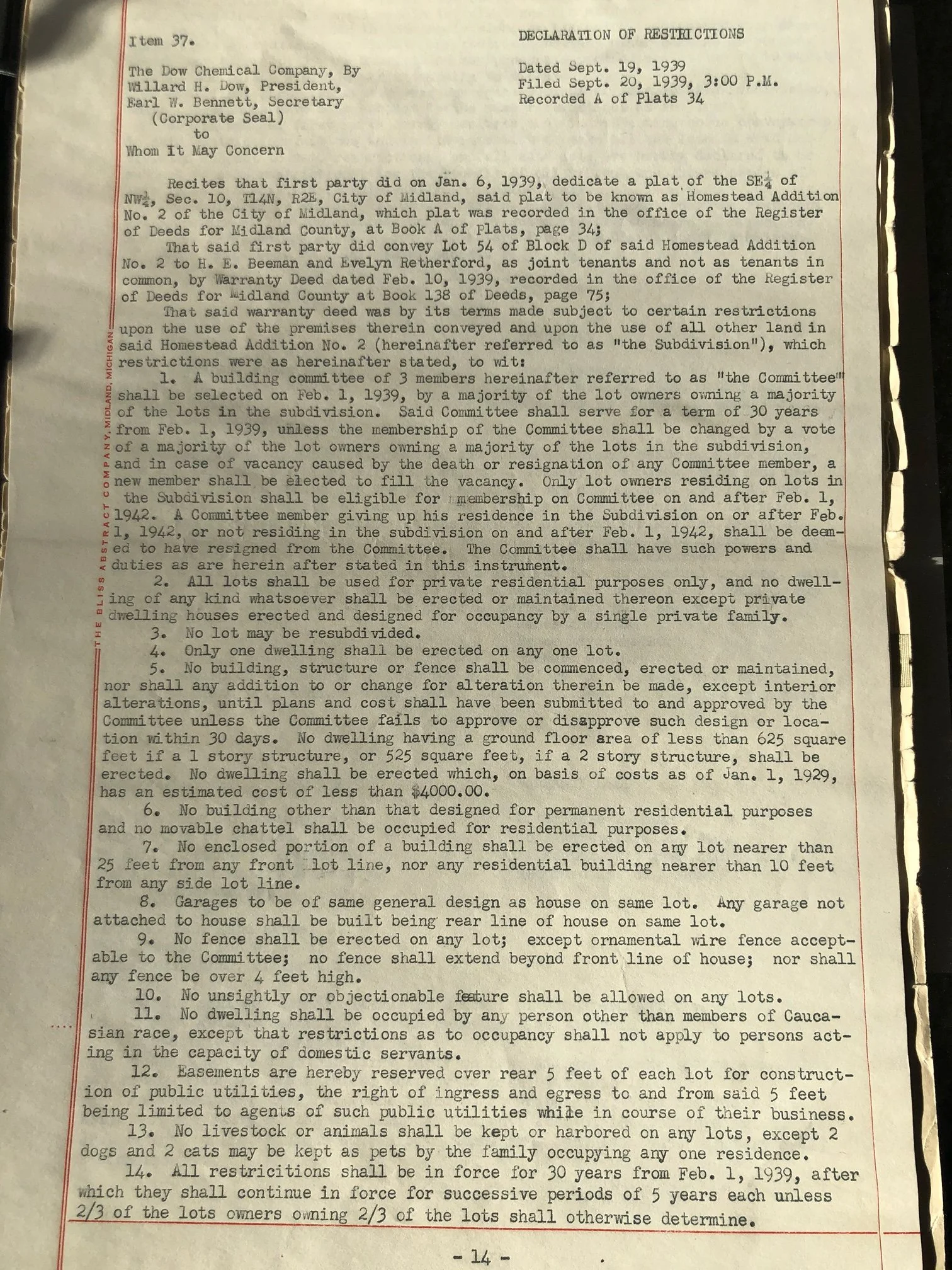
A housing covenant was a binding agreement attached to a house title that outlined specific rules, rights, and practices for the property. During the twentieth century, restrictive housing covenants were used to prevent nonwhite people from purchasing homes in predominantly white neighborhoods. Between 1939-1947, Midland had at least six housing developments with anti-Black covenants.
Realtors encouraged covenants and lobbied the U.S. Congress and state legislatures to maintain their legality. Although the Supreme Court outlawed covenants in 1948, realtors continued to lobby for their use well into the 1960s.
Sometimes a Black person would circumvent the covenant using a practice called a “strawman purchase,” where a white ally would act as the buyer of the home and then transfer the deed to the Black purchaser. These were difficult deals to make because it required the Black purchaser to raise the entire sum in cash; they could not get a mortgage. If a Black buyer successful purchased a home in a white neighborhood, realtors would use a practice called “panic peddling” to scare white homeowners in to selling their homes quickly at lower than market values. These homes would be bought by speculators who would raise the price higher than market value to sell to Black people. The practice meant that neighborhoods often “browned” quickly after a Black family moved in, instilling a socially constructed segregation.
This housing covenant in Midland from 1939 states: “No dwelling shall be occupied by any person other than members of Caucasian race, except that restrictions as to the occupancy shall not apply to persons acting in the capacity of domestic servants.”
